



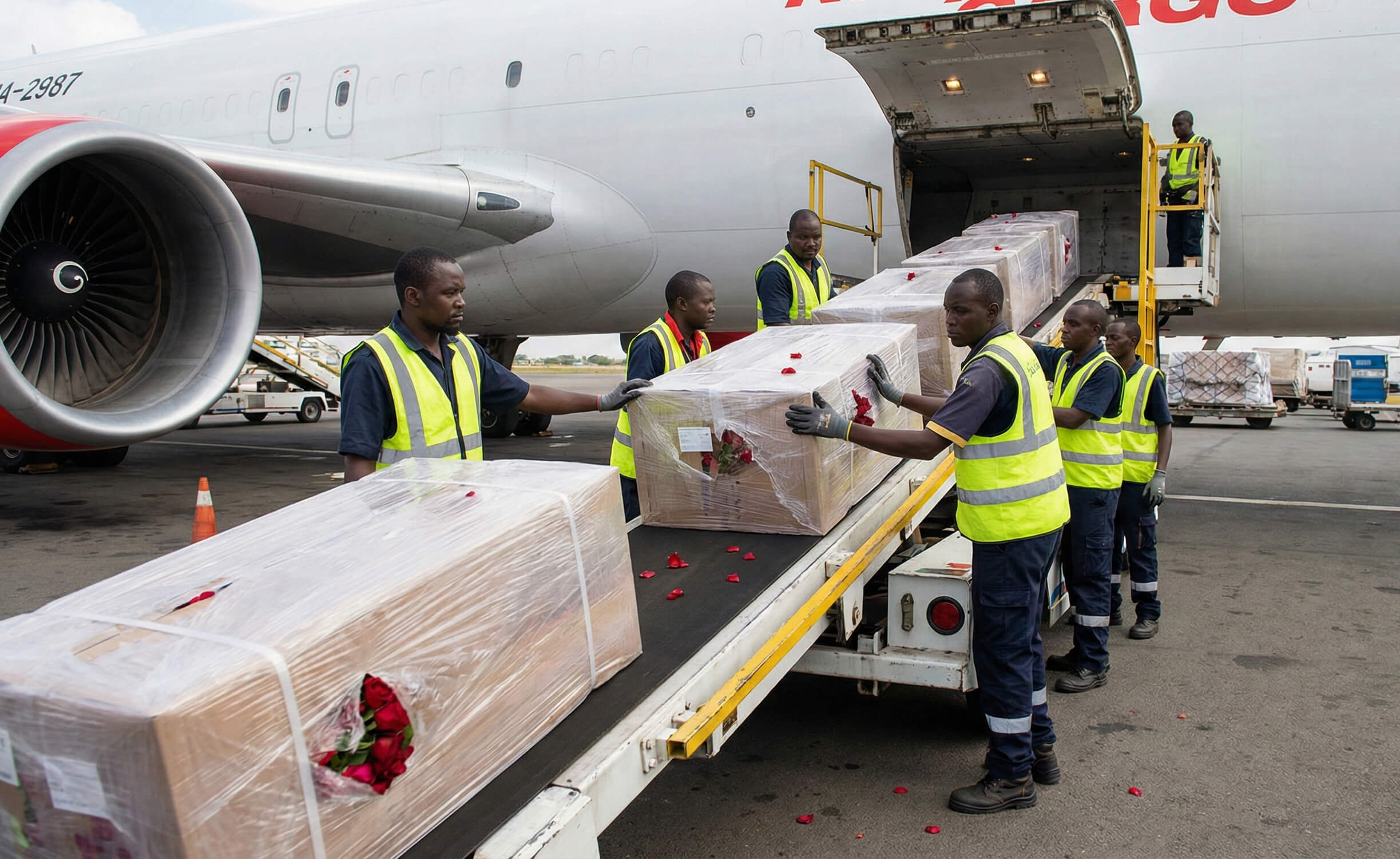
By Bonface Orucho: Africa continues to assert itself as a global powerhouse in cut-flower exports, supplying European and Middle Eastern markets with industrial-scale precision each year.
Africa’s floriculture industry demonstrated its global strength during the 2026 Valentine’s rush, moving over 7,000 tonnes of flowers from two airlines in Kenya and Ethiopia. The surge highlights both the sector’s logistical sophistication and the pressures on air cargo and cold-chain systems.
The 2026 Valentine surge alone moved over 7,000 tonnes of flowers from Kenya and Ethiopia, compressing months of cultivation into a tightly executed logistics window. February has become the continent’s clearest stress test for air cargo and cold-chain capacity, according to industry analysts.
“The compressed February window highlights both opportunity and risk. While demand is surging, infrastructure bottlenecks in air cargo and cold storage remain a pressing concern,” said Arnold Mukonza, a Kigali-based supply chain manager. He noted the need for investment in “specialized freighter fleets” and “temperature-controlled handling” over the next five years.
In the lead-up to Valentine’s, cargo aircraft from Nairobi and Addis Ababa fed auction floors, wholesalers, and retail chains across Europe and the Gulf in under three weeks. Ethiopia’s horticulture industry airlifted 3,425 tonnes, while Network Airline Management moved over 3,100 tonnes from Nairobi to Liège across 31 Boeing 747F rotations, each carrying more than 100 tonnes. Nairobi alone handled more than 1,300 pallets, averaging 2.3 tonnes per pallet.
Liège Airport processed 13,850 tonnes during the four-week Valentine campaign, supported by 45 additional charter flights, with individual consignments valued up to US$1 million, highlighting the high stakes in Africa’s floral trade.
“Flowers harvested in Kenya’s Naivasha basin or Ethiopia’s highlands must reach auction floors within hours, not days. Cold-chain integrity between 2–8°C is maintained throughout transit,” said Emirates SkyCargo.
To address capacity gaps, Magma Aviation and MidnightZulu launched a scheduled Nairobi–Liège weekly service, operating January through May 2026. The service complements four existing flights on the route, providing predictable peak-season capacity.
Seasonal partnerships like these smooth bottlenecks, strengthen corridor resilience, and signal growing confidence in Africa’s perishables trade. Nairobi’s role as a logistics hub is increasingly reinforced by such market-driven investments.
Kenya remains one of the world’s top flower exporters. According to 2025 World Integrated Trade Solution data, Kenya and Ethiopia rank among the top 10 global cut-flower exporters. Kenya’s flower industry earned 108 billion shillings (US$835 million) in 2024, up from US$827 million in 2023. Kenya Airways transports roughly 5,000 tonnes annually, with peak Valentine’s capacity reaching 550 tonnes per week.
Geography reinforces Africa’s advantage. Flights from Nairobi to Western Europe average eight hours, shorter than transatlantic routes from Latin America, reducing fuel burn, transit risk, and spoilage exposure, according to RaboResearch.
Beyond Europe, Dubai’s flower hub processed 227,530 kilograms in five days ahead of Valentine’s, with daily volumes nearly doubling normal throughput. Most shipments originated from Kenya and Ethiopia, reflecting growing Africa–Middle East trade integration.
Valentine’s highlights a broader structural shift. Air cargo is evolving from a secondary revenue stream into a strategic corridor supporting perishables, pharmaceuticals, electronics, and e-commerce. Across the continent, investments in narrowbody freighters, upgraded cargo terminals, and digitized customs clearance are expanding distributed capacity.
DHL added two Boeing 737s to strengthen West Africa’s air cargo in January, while Lufthansa Cargo expanded its A321 freighter network to deepen Europe–Africa connectivity. Regional operators like Royal Air Maroc Cargo and Astral Aviation are scaling operations, signaling the gradual building of distributed freight capacity beyond hubs like Addis Ababa, Nairobi, and Johannesburg.
In Ethiopia, the Valentine uplift was 18.5% lower than last year, yet more than 3,400 tonnes moved through Addis Ababa’s cargo system in under a month, underscoring its status as a major perishables hub.
Kenya’s floriculture sector is a decades-long success story. Production began in the late 1960s and expanded from low-input fields to high-altitude greenhouses. Roses account for 66% of export value, estimated at 40 billion Kenyan shillings (US$311 million) in 2022, representing 12% of national export revenues. Production spans over 15 counties, including Naivasha, Mount Kenya, Nairobi, Thika, Nakuru, Kericho, and Eastern Kenya.
The sector is also an employment engine. Over 90,000 people work directly on farms, while 500,000 depend on the industry. Women make up at least 50% of the workforce, performing harvesting, sorting, and bouquet-making roles. Farms also support education, healthcare, and local infrastructure.
Africa contributes 17% of the global cut-flower trade, worth roughly US$1.4 billion annually. Kenya provides 7%, Ethiopia 2%, with other producers including South Africa, Zambia, and Tanzania. Major importers are the Netherlands, the UK, Germany, Russia, and Norway.
Policy adds new complexity. The UK’s two-year suspension of its 8% global tariff on cut flowers is set to expire. Kenya supplies an estimated 40% of Europe’s roses, with the UK accounting for 18–20% of total exports. A return to duties could raise landed prices, pressuring margins in a sector supporting over 200,000 direct jobs.
Kenya retains partial protection under the 2021 UK–Kenya Economic Partnership Agreement (EPA), with duty-free quotas saving around £10 million annually. However, transit shipments via the Netherlands remain fully exposed once the suspension lapses, according to Kenya Flower Council CEO Clement Tulezi.
Global diversification is gaining momentum. From May 2026, China will slash tariffs on imports from nearly all African countries. Kenya’s early-harvest trade agreement with Beijing, signed in January 2026, grants 98.2% duty-free access, boosting competitiveness in Asia’s largest consumer market.
bird story agency
Summary not available at this time.