


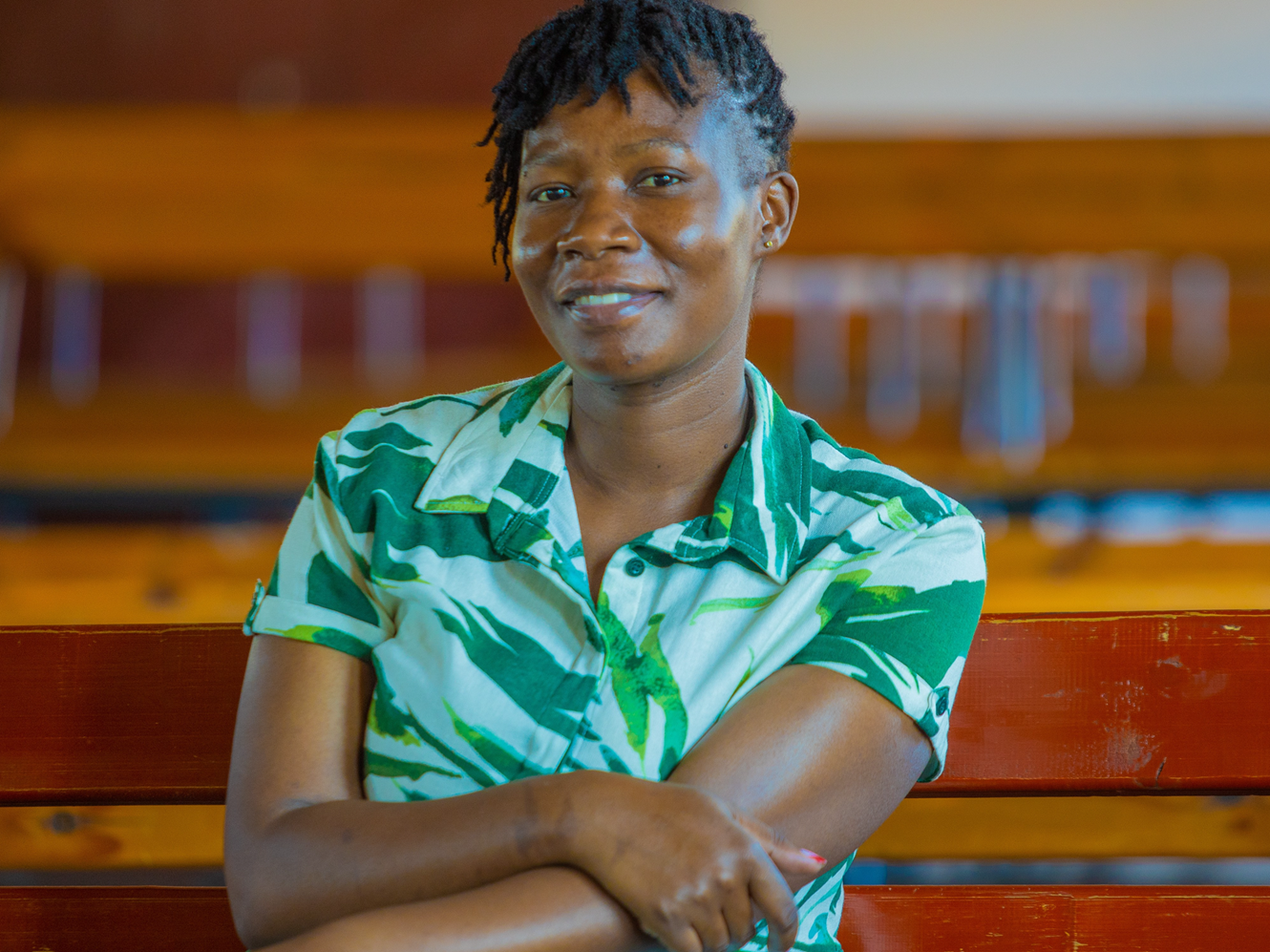
Batsirai Zhou’s father was often away owing to his sugarcane business, so she spent her formative years primarily with her mother.
In 2009, her father retired and rejoined the family—albeit not for long. Two years later, when Zhou was in lower sixth form, her father passed away, leaving her mother to navigate life alone in a society that systematically diminishes women’s power and voice.
Growing under her mother’s wings would groom her in activism and ultimately shape her life’s task in Zimbabwe’s Apostolic churches.
Roughly 34% of Zimbabwean women aged 20-24 are married before age 18, according to UNICEF data. Having never attended school herself, Zhou’s mother was determined to help her daughter break through the limitations and become an independent woman.
In 2017, having passed her advanced levels with 11 out of 15 points, she enrolled at Midlands State University to study development studies. There she lived with her aunt, a widow.
Zhou, however, observed a negative trend in her community. Young women were routinely denied higher-education opportunities. Thus began her advocacy towards equal rights for women. She urged more of her friends to advance their education
“I realised that being a gender equality and social inclusion person doesn’t necessarily need you to have a professional certificate,” she reflects, “but a passion and a political will.”
At university, Zhou joined various clubs committed to gender equality. Most club members hailed from privileged families, and this limited her from contesting leadership positions owing to her rural background.
In time, though, she shed much of that fear and began speaking with confidence on gender issues. In 2021, after a volunteering stint with the Diocese of Mutare Community Care Programme (DOMCCP), Zhou pursued a Master’s in Gender and Policy Studies at the Great Zimbabwe University.
She also acquired certifications in Applied Research Methodology and project management, monitoring and evaluation.
Journey through SASA Faith
Data reports a normalised culture of gender-based violence in Zimbabwe. At least 47% of women aged 15-49 typically confront physical or sexual violence from an intimate partner, according to the Zimbabwe Demographic and Health Survey.
With victims predominantly Christians, Zhou started an initiative in 2018 to dismantle this culture of violence through faith-based advocacy.
SASA Faith, which draws on a similar initiative in Uganda, partners with Apostolic churches to explain the Scripture’s position on justice, dignity and child protection. The church’s choice is indeed strategic. Apostolic churches boast around 6.3 million adherents, roughly 37% of Zimbabwe’s population.
By itself, SASA stands for Start, Awareness, Support and Action—a framework structured to derive the most impact from its host communities. Yet, Zhou explains, the work demands an inordinate amount of courage.
As she learnt early on, confronting religious leaders head-on about legal requirements often met a wall of resistance.
“The moment you say gender, you open your mouth saying gender, the conflict starts,” she explains, “because you are challenging the status quo.”
Many saw equality as being dispossessed of their leadership power. To bypass the fierce opposition, Zhou resorted to winning them over through Scriptural analyses.
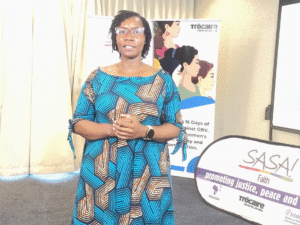
Generally, the Start phase involves training community cadres: community activists who facilitate discussions in faith spaces, religious leaders who provide theological guidance and deliver sermons promoting non-violent interpretations of scripture, and community action groups comprising social services, police, women’s affairs ministries, and civil society organisations responding to violence.
Traditional leaders are also engaged to ensure a coordinated community response. Once these structures are established, participants reflect on their own use of power, unlearning behaviours that promote violence.
The Awareness phase sees community activists using tools including power posters, community conversations, discussion guides, dramas, and radio story ideas to sensitise their faith communities. They share referral pathways for accessing help, ensuring survivors know where to turn.
A rapid assessment survey is designed to measure whether communities have achieved 60% awareness of what constitutes violence: recognition that some people experience violation without understanding it as such due to socialisation.
Upon reaching this threshold, the programme advances to the Support phase, where activists receive training on survivor-centred approaches that respect individual circumstances and boundaries.
The Action phase translates awareness into concrete change. Faith communities establish gender desks staffed by both women and men, recognising that some women feel uncomfortable reporting sexual violence to male religious leaders.
Churches develop measures to prevent and respond to violence, moving beyond prayers to practical intervention. Zhou explains that the progression from awareness to mobilisation is a corollary of the Bible verse saying “faith without works is dead.”
Media and advocacy strategies reach broader audiences through social media, radio and television, though Zhou acknowledges their limited effectiveness in rural areas. Over 67.4% of the general population lacks regular internet access.
Community mobilisation draws more impact, with volunteers meeting people where they are, facilitating discussions using visual materials and guided questions that prompt reflection.
The work exacts personal costs still. Zhou has been labelled “hotheaded” and “unbiblical” by those uncomfortable with women’s empowerment. Some view her as unmanipulable.
Speaking on World Human Rights Day, coinciding with the final day of the 16 Days of Activism Against Gender-Based Violence, Zhou addresses digital violence’s growing threat.
“Behind every keyboard there is a person,” she stresses, noting how digital spaces, for all their opportunities, have become unsafe for women.
She rejects the notion that digital violence is somehow lesser than physical violence, insisting both inflict equivalent damage.
Zhou’s current vision for SASA Faith’s future, as the current project concludes in 2027, centres on fundamentally restructured communities where men and women share power, opportunities, and ownership equally across all spheres.
She envisages marriages where spouses jointly decide financial matters and co-own assets, replacing current patterns where men’s names appear on title deeds, livestock papers, and house documents while women accumulate only blankets, pots and wardrobes—items lacking financial value or sustainability.
Throughout her journey, Zhou confronted an overwhelming fear of speaking imperfect English. She has since overcome that hesitation, prioritising communication over perfection.
“If you do not open your mouth in front of injustice,” she insists, “you are complicit with those who are violating. You take the side of the oppressor.”
Summary not available at this time.