



Nigeria’s long-standing struggle to expand non-oil trade has slowed economic diversification, reduced export competitiveness and kept small and medium enterprises (SMEs) from accessing regional markets.
Despite hosting one of Africa’s largest consumer bases and a growing industrial sector, the country continues to grapple with weak logistics infrastructure, high trade costs, low value-addition and fragmented market linkages.
In agribusiness, low processing capacity, inadequate financing and cumbersome documentation processes further cramp growth.
As Nigeria seeks to strengthen its position in the African trading landscape, unlocking structured regional relationships has become pivotal.
One promising avenue is closer engagement with broader regional blocs where untapped trade potential remains significant.
Trade between African and Arab countries remains well below capacity. Nigeria’s Ministry of Finance estimates that trade volumes between the two regions could expand by over $37 billion within the next three years if properly harnessed.
Yet Nigeria, despite its economic size, contributes less than 10% of intra-African trade and continues to rely heavily on imported finished goods while exporting mostly low-value raw materials.
Agriculture accounts for about 21% of national GDP but less than 5% of exports, highlighting the country’s weak value-addition capacity.
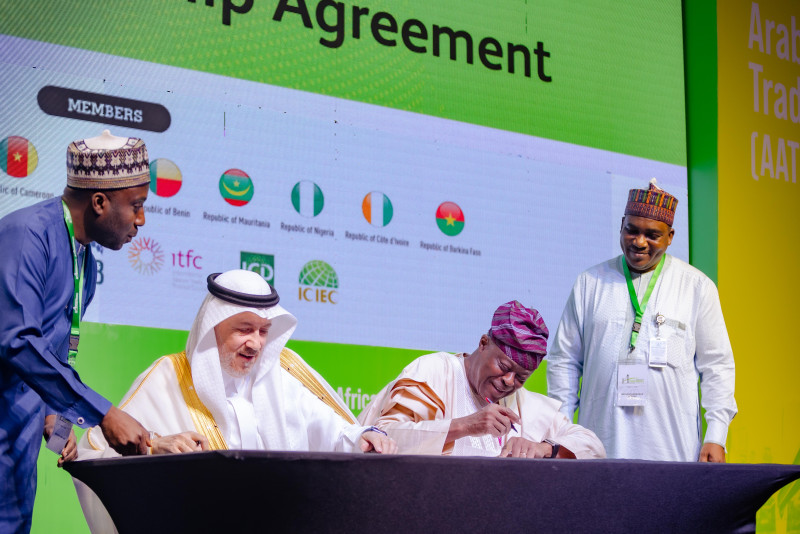
Nigeria’s accession to the Arab Africa Trade Bridges (AATB) Programme presents an opportunity to address age-old trade and industrial bottlenecks.
The partnership is expected to strengthen value chains, diversify exports and expand access to trade finance. Through AATB, Nigeria stands to benefit from upgraded agribusiness capacity, improved processing and certification for export, and broader support for SME development.
The programme also promotes improved trade facilitation and logistics, including support for Nigeria’s National Single Window to streamline documentation and processing.
Regional business missions will help connect Nigerian producers to high-demand Arab markets, while AATB institutions provide the technical assistance, financing and capacity building needed to drive reforms.
Nigeria’s participation in AATB aligns with other regional and global trade modernisation efforts.
The country is working to improve market access for small manufacturers and harmonise customs procedures under the African Continental Free Trade Area, or AfCFTA.
Complimentary programmes such as the Afreximbank Intra-African Trade Fair, the Nigerian Export Promotion Council’s Zero-to-Export initiative, and the Special Agro-Industrial Processing Zones aim to strengthen export-driven growth.
AATB enhances these interventions by connecting Nigeria not only within Africa but also to high-demand markets across the Arab region.
However, Nigeria must address several structural challenges to fully benefit from the programme. These include port congestion, inadequate rural infrastructure, inconsistent regulatory standards and limited financial support to SMEs.
Without reforms, the country risks missing out on deeper regional integration opportunities. Efforts to revitalise sectors—such as leveraging digital trade in ICT—will also require stronger coordination and enforcement.
Nigeria’s membership in the Arab Africa Trade Bridges Program marks a shift towards unlocking development through enhanced trade, stronger agribusiness competitiveness, and expanded industrial growth.
By tapping into new markets, securing investment partnerships, and strengthening technical capacity, Nigeria can accelerate its transition from a commodity-dependent economy to one that adds value through processing and trade.
Summary not available at this time.