



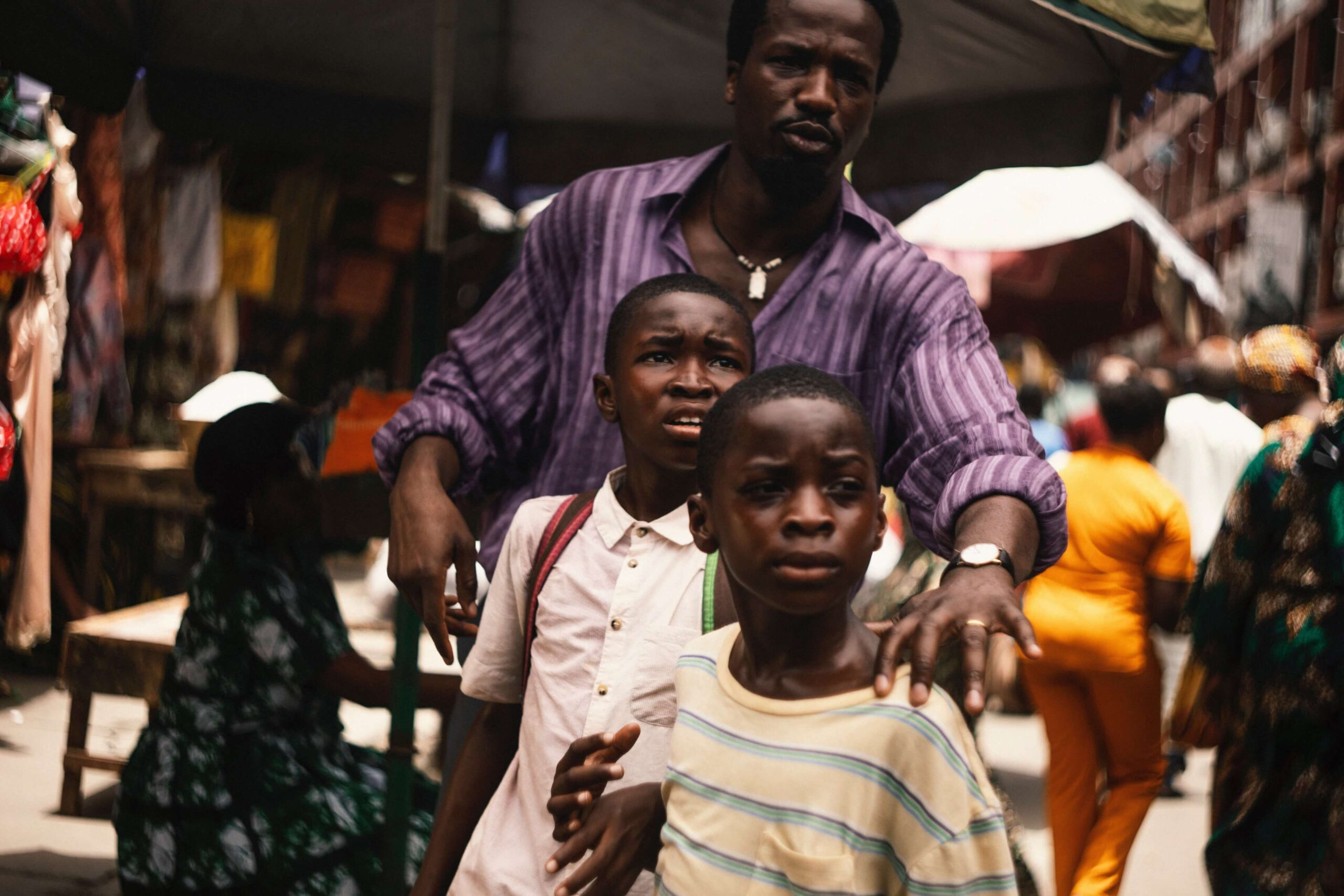
By Bonface Orucho: Set during Nigeria’s controversial 1993 annulled presidential election, a new film, My Father’s Shadow, follows a father navigating Lagos with his sons as civil unrest simmers. The film turns political rupture into a family and fatherhood memory by grounding history in domestic life rather than spectacle.
The film opens in rural Nigeria, where two young brothers, Akin and Remi, fill the quiet with childhood play and small quarrels. Their relationship is intimate but shaped by absence. Both boys speak of their father, Folarin, with admiration that borders on reverence, even though he is rarely home.
Folarin works in the city, a man whose presence is imagined as much as experienced, the provider somewhere beyond their everyday world. That early calm setting sets up the contrast that defines My Father’s Shadow, the private tenderness of family life against the coming urban chaos of Lagos in 1993.
It belongs to a new African cinema that tells political history through interior life rather than spectacle.
The film, the debut feature by British-Nigerian filmmaker Akinola Davies Jr., co-written with his brother Wale Davies, uses one day in Lagos to show how national rupture is carried quietly inside families. Set against Nigeria’s 1993 annulled election crisis, the film follows a father travelling across the city with his two young sons as civil unrest simmers around them.
Rather than centering generals or violence, the film remains grounded in domestic intimacy, according to Davies Jr., who told Euronews that the story visualises masculinity, generational trauma, and the fragility of national identity during political unrest.
“My writing process is very specific, I need to be completely detached from everything,” Wale Davies said, describing how the script was first drafted during writing retreats in Ghana’s Volta Region.
The story is fictional, but its emotional roots are personal. Davies Jr. has explained in interviews that the film was born from the death of his and Wale Davies’ father when they were young, leading them to imagine what a day with him might have looked like.
“It made me weep,” Davies Jr. said of the first script draft. “I had never conceived of a story about our lives but fictionalised in this way.”
That emotional core is what gives My Father’s Shadow its force. However, the film is not simply about a political crisis. It is about fatherhood shaped by absence, masculinity under pressure, and the fragile inheritance children carry when history interrupts ordinary life.
At the centre of the film is Folarin, a father figure who is not a direct portrait of the Davies brothers’ own father, but an archetype. Davies Jr. describes him as recognisable, charismatic, and hardworking, presenting strength while carrying softness underneath.
Over the course of the day, Folarin learns that provision is not only financial. His purpose is not simply earning wages, but being present with his sons, according to Davies.
Actor Ṣọpẹ́ Dìrísù, who plays Folarin, said the role offered a rare opportunity to portray tenderness without sentimentality.
“When I was first sent the script, I was excited just to be working in Nigeria,” Dìrísù said. “To tell a story as tender, beautiful and considered as this one is an opportunity not a lot of actors get.”
Casting was central to making the father believable. Davies Jr. said the role required not only talent but physical presence.
“We needed someone who could communicate masculinity on a surface level,” he said. “When I met Dìrísù, there was something about the way he carried himself, honourable, respectful, present.”
Producer Rachel Dargavel said the team felt Dìrísù was always meant for the part.
“We started to manifest him in the role,” she said, noting they followed his work long before approaching him.
Wale Davies said Dìrísù embodied both strength and vulnerability.
“He has this masculinity, but also a softness in his eyes that shows you his layers,” Davies said.
Just as important was the relationship between father and sons.
The film’s two young leads, Godwin Egbo and Chibuike Marvellous Egbo, were discovered through an extensive search across Nigeria’s communities.
“In Nigeria, we don’t necessarily have an agency where you can source child actors,” Davies said. “It’s a mixture, looking in schools or acting groups.”
Davies Jr. recalled recognising something immediate in the boys during workshops.
“They were really supportive of each other and picked things up quickly,” he said.
Only later did the team learn they were brothers in real life. That natural intimacy became an emotional anchor for the film.
“The way they hold hands, the way they look at each other, it was absolutely a blessing,” Dargavel said.
Dìrísù described the bond that formed on set as deeply authentic.
“We’ve developed a really close bond over the time we have been working together,” he said.
The story’s tenderness unfolds against one of Nigeria’s most contested political moments. The annulment of the June 1993 presidential election, widely believed to have been won by Chief Moshood Abiola, triggered protests and unrest that deepened a long period of military rule. In the film, that national tension becomes atmosphere, the sense of disorder gathering just beyond the family’s fragile orbit. Folarin’s journey across Lagos is shaped by that uncertainty. According to The Guardian, he is on a desperate mission to reclaim months of unpaid wages before what he expects will be a breakdown of law and order connected to the election crisis. The delays and detours of the day, buses without petrol, improvised rides, long waits for a man who never arrives, become the space in which father and sons begin to truly see one another.
Critics have highlighted how the film uses political context as texture rather than spectacle. According to Rotten Tomatoes, the film weaves high-stakes political commentary with rich personal dynamics, anchored by a commanding performance from Dìrísù that reveals what families leave unspoken.
AP News called the film “poignant,” noting that cinematographer Jermaine Edwards’ use of 16 mm film captures a vibrant and emotionally resonant portrait of Nigeria on the brink of change.
The Week describes it as a “magically nimble love letter to Lagos,” praising its tender storytelling, inspired casting, and emotional depth. The film’s impact has also extended beyond reviews.
My Father’s Shadow screened at the Cannes Film Festival, where it received a Caméra d’Or Special Mention, marking Davies Jr.’s arrival as one of the most closely watched new voices in African cinema.
It has since continued its international festival journey, including a North American premiere at the Toronto International Film Festival.
Lagos itself is treated not as a dysfunction but as an archive.
“I see a film every day in Lagos,” Davies Jr. said. “In the film, Lagos is a living, breathing character with its own detail.”
The city’s textures, markets, traffic, and heat become part of the emotional language of the film.
The filmmakers insisted on shooting in Nigeria to preserve authenticity, despite logistical complexity.
“At one point, we had about twenty-seven locations,” Dargavel said, describing the scale of the production.
bird story agency
Summary not available at this time.