

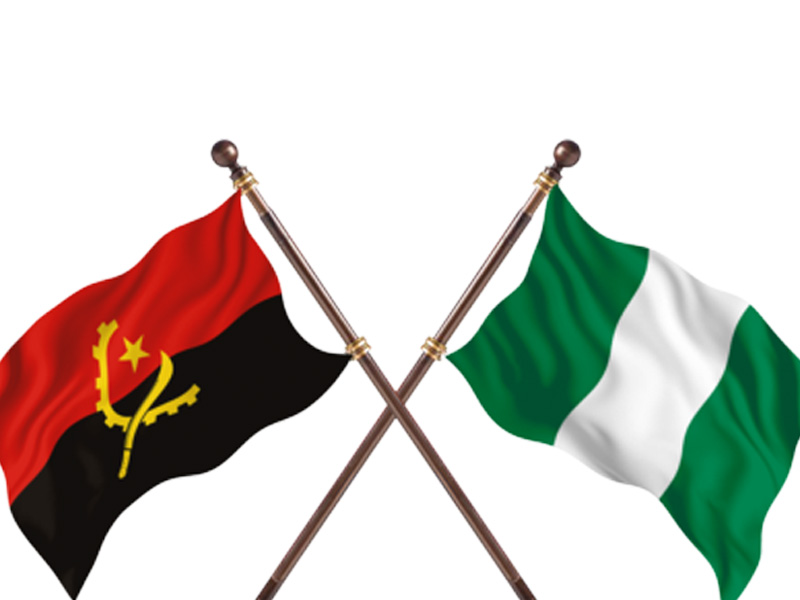
Nigeria and Angola are working on 29 cooperation agreements and memoranda of understanding, including visa exemptions and business partnerships designed to boost commerce between Lagos and Luanda.
In September 2025, they convened the Fifth Session of the Nigeria-Angola Bilateral Economic Joint Commission in Luanda, reviewing over 20 agreements covering defence, security, digital diplomacy, trade, economy, culture, transport and telecommunications.
Yet despite 49 years of diplomatic relations and shared historical ties dating to Angola’s independence struggle, actual trade between the nations remains remarkably modest.
Between 2020 and 2022, Angola exported just $5.6 million worth of goods to Nigeria while importing $16.8 million, creating a negative trade balance of $11.2 million.
Angola invested $4 billion in renewable energy infrastructure, including photovoltaic, green hydrogen, biofuel and hydroelectric dams, targeting eight gigawatts of electricity capacity by 2025, signalling economic diversification beyond oil that creates opportunities for collaboration with Nigerian states possessing complementary strengths.
Nasarawa State occupies a unique position within Nigeria’s federal structure. Bordering the Federal Capital Territory, the state mirrors Bengo Province’s relationship with Angola’s capital, Luanda. This geographic parallel creates natural alignment, but Nasarawa’s economic fundamentals provide the substance for cooperation.
Agriculture dominates land use at 45.3% of the state’s 27,117 square kilometres, with over 80% of the 2.5 million population engaged in farming. The state produces sesame, soybeans, groundnut, millet, maize and yam across vast arable lands, achieving remarkable progress under targeted interventions.
The state recently harvested 1.2 million bags of rice from 3,300 hectares, demonstrating significant capacity for agricultural transformation and food security contributions. Mining activities contribute 15.1% of land use, with the state extracting limestone, marble, coal, tin, iron ore, bauxite and various gemstones.
Nasarawa is known as the “Home of Solid Minerals,” holding deposits of dolomite, sapphire, talc, quartz, tantalite, and other resources that remain largely unexploited due to artisanal mining practices and limited industrial-scale extraction.
The memorandum of understanding signed between Nasarawa State and Bengo Province formalises cooperation in agriculture, mining and education.
Both governments identified mutual areas of comparative advantage after recognising similarities between their economic structures and challenges.
The state brings agricultural expertise in specific crops and techniques, while Bengo offers strengths in other agricultural domains. In mining, the partnership creates opportunities for technology transfer, investment attraction, and sustainable extraction practices that move beyond artisanal operations toward industrial-scale development.
Education cooperation enables knowledge exchange, capacity building and institutional strengthening that supports long-term economic transformation.
Perhaps most significantly, Nasarawa inaugurated a One-Stop Shop Investment House specifically for Angolan investors, removing bureaucratic barriers and providing streamlined pathways for capital deployment into identified priority sectors.
The state recorded an N54.03 billion opening balance in Q1 2025, demonstrating improved fiscal management. Total revenue, including opening balance, reached N96.36 billion, representing 25.1% of the N384.32 billion annual target.
The state government allocated considerable funding toward water supply, agriculture, and security based on citizen consultations, while pursuing broader goals of fostering a modernised economy through digitisation, manufacturing expansion and agricultural empowerment.
Infrastructure investments include agricultural equipment procurement alongside road construction, hospital facilities, and educational infrastructure. These developments create the foundation for partnership implementation, as improved infrastructure enables efficient movement of goods, technical experts and investment flows between cooperating regions.
The broader Nigeria-Angola relationship provides institutional support for state-level partnerships. Federal-level agreements on drug control and cultural cooperation, twinning arrangements between Bayelsa State and Angola’s Namibe Province, and the Angola-Nigeria Business Council established to drive private sector cooperation all create ecosystems supporting Nasarawa-Bengo collaboration.
Twenty-eight draft memoranda of understanding tabled during the bilateral commission meetings cover trade, education, science, technology and infrastructure, with additional agreements expected as relations deepen.
Visa waiver plans and simplified customs procedures will facilitate the movement of people and goods, reducing friction in cross-border economic activities.
The challenge that may likely occur is that Nasarawa’s economy remains heavily tilted toward agriculture, with approximately 70% of the population as peasant farmers.
Infrastructural facilities, including energy, water supply, transportation, communication, and roads, remain poor and inadequate to stimulate desired investment inflows.
Farmer-herder conflicts over land rights continue to disrupt agricultural activities. The state’s heavy dependence on federal allocations limits fiscal autonomy and development capacity.
For Angola, economic diversification beyond oil remains incomplete despite stated commitments and renewable energy investments.
The Nasarawa-Angola partnership represents a model for South-South cooperation where African regions leverage complementary strengths, share knowledge accumulated through similar development challenges, and build economic relationships not mediated through former colonial powers or distant global partners.
Summary not available at this time.