


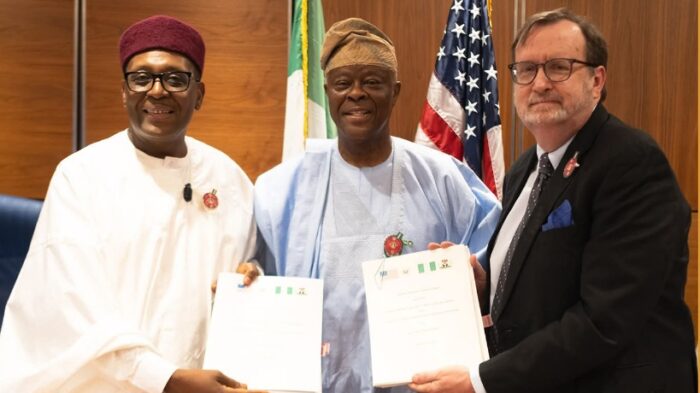
The newly signed five-year bilateral health agreement between the United States and the Nigerian governments indicates a paradigm shift in how the Nigerian healthcare system receives financing.
Essentially, the memorandum of understanding includes almost $2.1 billion in US funds, in addition to an expected $3 billion in additional Nigerian health spending.
This focus on religious healthcare institutions indicates the governments’ acknowledgement of the integral contributions such institutions have made in the Nigerian healthcare system, particularly in areas where the healthcare system remains understaffed.
This deal also reflects a new approach to co-investment and bilateral accountability in line with the America First Global Health Strategy.
By linking funding with domestic spending increases and system reforms, this deal puts responsibility on healthcare assistance as something that is a community concern, not simply a result of a foreign intervention.
The faith-based healthcare facilities, which are believed to provide 900 clinics and a hospital covering more than 30 percent of the population, not only show their importance in providing a system of care but also raise new questions in respect to overall healthcare system strengthening in Nigeria.
Apart from the above agreement, there are other solutions that are already in place to address health issues in Nigeria.
One of the major initiatives that can be seen is through the National Health Act and the subsequent implementation of the Basic Health Care Provision Fund (BHCPF).
The Basic Health Care Provision Fund is an initiative that aims to address primary healthcare facilities in countries and allocate funds to enable activities such as immunisation and maternal and child health and treatment of common infectious diseases.
An expansion of health insurance coverage is another important solution. The National Health Insurance Authority Act is directed towards ensuring universal health coverage by requiring all Nigerian citizens to have health insurance.
The programme, which utilises the state health insurance schemes in collaboration with the private health maintenance organisations, has slowly begun to increase financial accessibility to the health services.
Despite the low coverage of the insurance reform programme in the informal employment sectors, the programme has helped reduce the cost of accessing the public and faith-based facilities for the poor.
Disease-specific programmes are also an important component of existing solutions. Nigeria’s HIV programme, with the help of existing frameworks such as the President’s Emergency Plan for AIDS Relief and the Global Fund (PEPFAR), has developed an effective testing, treatment and data framework for the disease.
This framework is being leveraged to integrate TB, malaria and maternal health efficiency strategies that also align with the idea of integrated care in the newly established bilateral agreement.
The existence of such networks, in organisations such as the Christian Health Association of Nigeria (CHAN), has ensured that health services are delivered in a coordinated manner in church-run hospitals for several decades now.
These health facilities are usually located in remote areas, thereby complementing the services being offered by the government.
There are networks between faith organisations and ministries of health, as well as other foreign organisations, which have already indicated how the services offered by non-government organisations can be incorporated into the health sector plans without repeating services.
Another area where the answer lies is in Health Workforce development. Projects supported by international and local institutions target training of community health extension workers, nurses and midwives.
Task-shifting policies ensure that necessary services are provided by trained non-physician healthcare providers. This improves system resilience, as it ensures that resources invested in the healthcare system are not in vain.
Digital health projects are also picking up momentum. Electronic medical records, disease monitoring, and logistics management systems, supported by organisations like the Nigeria Centre for Disease Control & Prevention, make information-stakeholder decisions.
This enables greater accountability for both internal and foreign funding allocations, making sure that the use of funding committed under MOUs such as that between the US Government and Nigeria is well monitored.
The health deal that has been structured at a cost of $2.1 billion emphasises the role of faith-based care in the overall health structure of Nigeria while at the same time re-emphasising the evidence of a collaborative investment and ownership model.
Nonetheless, the long-run success of this deal will largely depend on the nature of integration that will take place between this deal and other solutions that are already in place.
Summary not available at this time.