



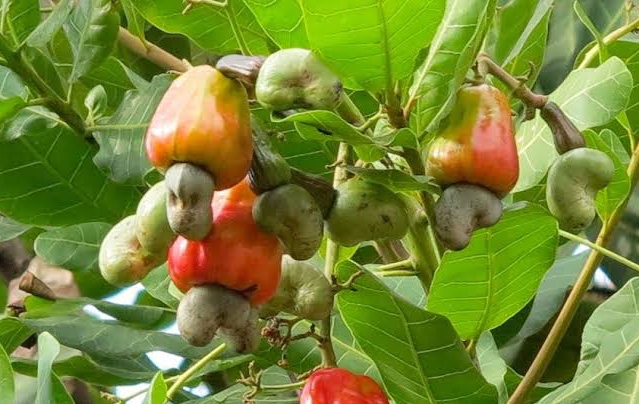
Nigeria ranks as the world’s fourth-largest cashew producer, yet it captures only a fraction of the commodity’s true economic potential.
In the first half of 2025, Nigeria’s cashew nut exports surged to $398.135 million, representing an 81.15% increase compared with $219.780 million in the same period of 2024.
Cashew nuts climbed to become Nigeria’s third-largest export product among 234 commodities tracked, signalling the crop’s rising significance in the nation’s non-oil export portfolio.
However, over 90% of these exports are mostly cashew nuts shipped to Vietnam and India for processing, meaning Nigeria loses the substantial value-added revenues that come from processing, packaging, and marketing finished cashew products.
Raw cashew nuts fetch approximately $1,500 per tonne at export, while processed kernels command prices ranging from $3,500 to $8,000 per tonne in international markets.
Kogi State tops the lists of producers, turning out roughly 55,000 metric tonnes annually from its eastern senatorial district alone.
This production concentration makes Kogi not merely a leading producer but the epicentre of Nigerian cashew cultivation, with vast plantations spreading across four local government areas—namely, Dekina, Igalamela-Odolu, Ofu, and Idah.
Despite this dominance, Kogi’s farmers have watched foreign merchants extract their crops at minimal prices, process them abroad and reap profits that dwarf what local producers receive.
The state generates an estimated N14 billion annually from cashew production, but this figure represents a mere fraction of potential revenues if processing occurred domestically.
Recent developments signal a fundamental transformation in this extractive pattern. The Kogi State government has formalised a partnership through a Memorandum of Understanding with a technical consultant specifically designed to restructure the value chain.
The agreement establishes new policies taking effect in 2026 that fundamentally alter how the cashew business operates in the state. Under these provisions, foreign buyers will no longer access farm gates directly but must engage licensed and registered local merchants.
All cashew nuts must undergo sun-drying within Kogi before leaving the state, ensuring local communities capture value from this essential processing step.
Most significantly, the state mandates that any entity seeking to purchase Kogi cashew must establish processing facilities within state borders, effectively compelling industrialisation rather than permitting continued raw material extraction.
So far, two firms have already indicated interest in establishing cashew-processing factories in Kogi, responding to the new investment requirements. The state plans to plant 15 million trees beginning in 2026, dramatically expanding production capacity to boost industrial-scale processing.
The introduction of customised jute bags will provide Kogi cashews with distinct branding and international recognition while enabling accurate tracking of quality and quantity.
This infrastructure of traceability, combined with processing requirements, positions Kogi to capture significantly larger shares of global value chains.
Consequently, Nigeria can process between 25,000 and 35,000 tonnes annually through existing facilities, yet currently utilises only one-third of this capacity.
Kogi’s policies could activate dormant processing infrastructure while stimulating construction of new factories, creating thousands of jobs in processing, packaging, quality control and logistics.
Women, who constitute over 70% of Nigeria’s workforce primarily in processing roles, stand to benefit disproportionately from expanded domestic processing. The state’s initiative addresses the fundamental problem identified by the Nigerian Export Promotion Council.
Cashew kernels demonstrated robust export performance in 2025, with values growing 40.29% to reach $26.851 million in the first half, ranking 4th among export products.
Rising health consciousness in Europe, North America and Asia fuels increasing demand for derivatives, including cashew butter, flour, milk and snacks.
Nigeria’s organic cultivation positions the country in premium organic markets where certified organic products command substantial premiums.
While the global cashew industry has surged within the past decade, Nigeria’s lags behind despite its worldwide status.
Hence, Kogi’s initiative provides a replicable model for other producing states, such as Oyo, Enugu, Kwara and Ondo.
However, Nigeria’s cashew sector comprises approximately 400,000 smallholder farmers averaging small cultivated areas with ageing trees and limited access to improved seedlings, mechanisation or agricultural credit.
Processing infrastructure remains inadequate, with only seven of twelve registered processors operational nationally. Transportation costs between production zones and processing facilities erode margins, while inconsistent power supply threatens processing efficiency.
The state’s success depends on sustained commitment beyond policy announcements, requiring investment in rural roads, reliable electricity for processing plants, agricultural extension services providing technical support to farmers and market intelligence helping producers understand quality requirements for premium markets.
Summary not available at this time.