


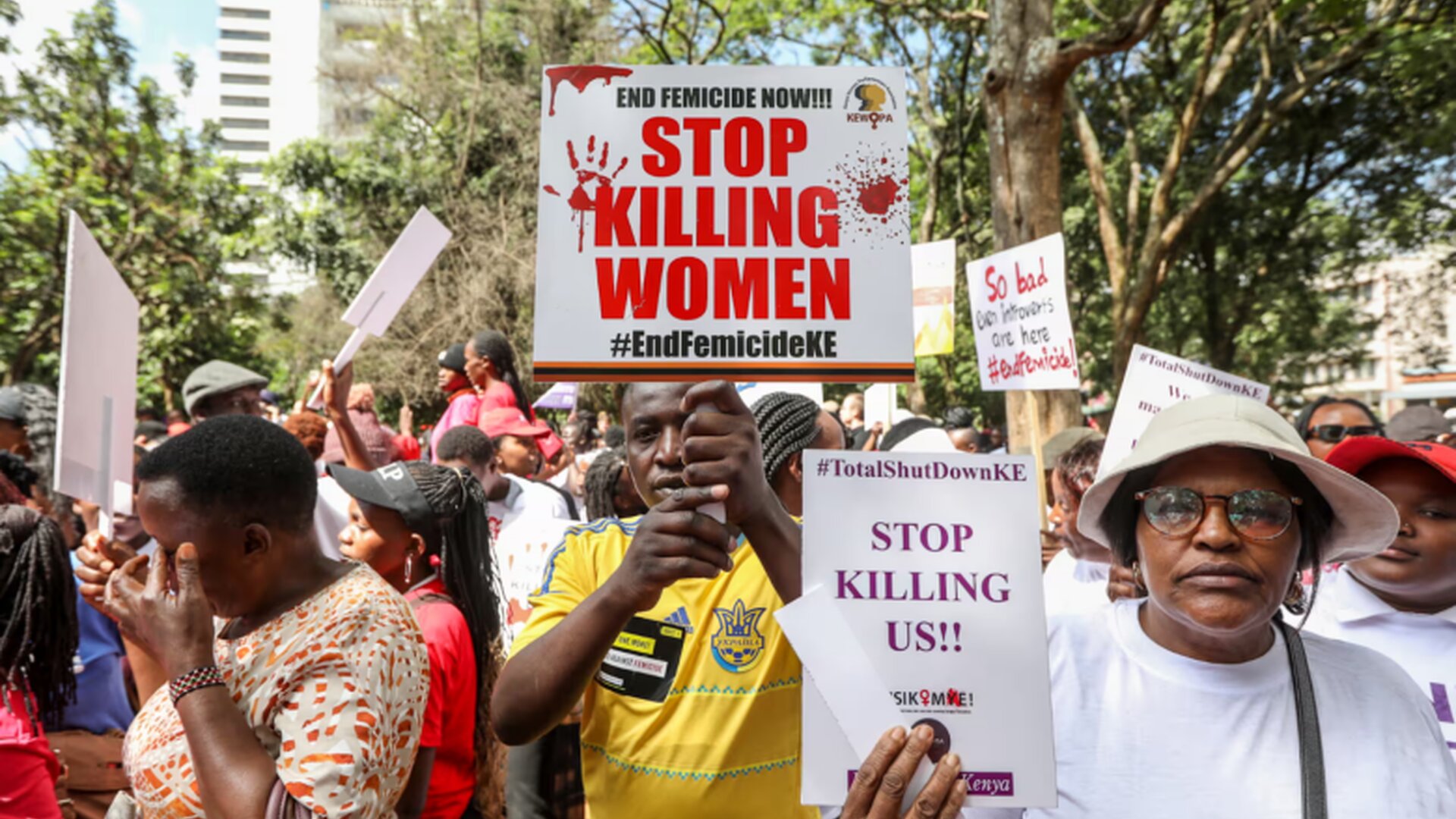
Home is considered a sanctuary for most, yet this is hardly true for countless Nigerian females. As femicide researcher Ololade Ajayi remarks, “home is one of the most dangerous places for women and girls.”
Every 49 hours in Nigeria, a woman or girl is killed—most often by someone she knows: a close relative, an intimate partner or an acquaintance.
Ajayi’s organisation, DOHS Cares Foundation, tracks femicide cases across Nigeria, and its open-source database shows that intimate-partner violence accounts for a significant portion of women killed in Nigeria in spaces that should offer refuge.
Data from the last five years reveals a disturbing surge in gender-based violence. During the first weeks of the COVID-19 lockdowns, reported cases rose by 149% across 23 states, prompting the government to declare a state of emergency on rape and domestic abuse.
Five years on, the crisis has hardly abated. Between 2020 and 2023, at least 27,698 cases—spanning sexual, physical and emotional abuse—were reported.
Femicide—the intentional killing of women because of their gender—has raised particular concern. DOHS Cares Foundation data reveals that reported cases spiked by 240% between early 2024 and the year’s end. In Lagos alone, the organisation tracked 135 cases.
Owing to family pressure and mistrust in law enforcement, many cases go unreported. This means that the actual tally is likely higher. And victims range from adults to children, based on DOHS’s data.
Nigeria’s prosecution gap
Nigeria introduced the Violence Against Persons Prohibition (VAPP) Act in 2015, criminalising harmful practices like female genital mutilation and economic abuse.
In Lagos State, the VAPP Act, along with domestic-violence laws, has created clearer pathways for survivors.
The state’s Sexual Assault Referral Centre reported handling over 8,000 cases in a single year, with increased advocacy in communities and schools.
Yet, while legislation exists, “implementation has always been a problem,” Ajayi notes. “Law enforcement is sometimes jeopardising these cases.”
In April 2021, the then-Minister for Women Affairs revealed that only 11 out of 3,000 reported SGBV cases from six states were prosecuted.
The National Agency for the Prohibition of Trafficking in Persons (NAPTIP) recorded 1,767 cases of SGBV in the four years leading to 2024. Yet only 362 convictions have been secured, with the rest mired in investigation and legal proceedings.
Along with their prohibitive costs, prolonged trials exact a severe emotional toll on affected families.
Police complicity is common. Survivors are encouraged to “settle” with their abusers, while some officers aid perpetrators by obstructing investigations.
“Victims’ families tend to give up either because they cannot afford what they need or they do not want to prolong their trauma,” Ajayi explains.
In the last 18 months, DOHS has rescued over 216 women and girls from various abuse situations—without government funding.
Families left behind
Beyond the victims lies another crisis: the absence of support for families left behind after femicide.
“Families of victims of femicide suffer so much trauma that there is nobody to attend to them,” Ajayi stresses. “For children of these victims, when their mother is killed by their father and their father has been going through the prosecution process in jail, what happens to these children? Who caters to them? There’s no provision for these ones.”
In April 2024, the DOHS submitted a femicide bill to the National Assembly and the Lagos State House of Assembly, which included provisions for victim compensation and family support.
Lagos lawmakers argued that existing homicide laws made a femicide law redundant.
“We replied to say no,” Ajayi recounts. “The law on domestic violence and murder does not cover the crime of femicide. Femicide is a hate crime that occurs intentionally because the victim is a woman. It stems from power disparity, misogyny and gender inequality. Femicide should be recognised as a distinct crime.”
The craze for fast money in Nigeria has made it especially dangerous for women and girls, who are targeted for money rituals.
A prime case is 13-year-old Oriyomi Gboyega, whose wrists were found in the possession of an Islamic cleric.
The GBV Data Disconnect
The lack of coordinated data is a notable challenge facing Nigeria’s GBV responses.
Cases typically turn up in police stations, hospitals and mortuaries, yet the data remains fragmented and inaccessible.
“The data is not synchronised,” Ajayi points out. “We need to have this national data, this dashboard that addresses this. The Federal Ministry of Women Affairs claims they have one. I’ve not seen any evidence of that, at least in the past few years.”
DOHS’s femicide tracker, which has become a critical resource for researchers and advocates, draws primarily on media reports and community notifications. This leaves out dozens of cases that never make the news.
Limited information means that the actual scale of the crisis is lost on policymakers, hampering interventions.
High-profile cases, elusive justice
Recently, several cases have elicited public outrage and calls for justice. One of these involves a teenage girl assaulted by her uncle.
“Victor Obange [the perpetrator] has not been declared wanted. He’s still out there. He must be arrested, arrested and prosecuted,” Ajayi insists.
Yet each case follows a troubling pattern: public attention creates temporary pressure, but once the social media fury dies down, cases stall. DOHS has documented many more cases, including that of a Deborah Moses, stabbed to death in Lagos in July by her ex-boyfriend.
“There was a kind of social media uproar about it, but after one or two weeks it died down,” Ajayi notes. “While these cases die down, we are still following up on the justice process to ensure that these victims get justice.”
What must change
Ajayi’s three priority reforms Nigeria should implement are grounded in years of frontline experience: support and fund civil society organisations doing this work, create more safe spaces for survivors, and implement legal reforms that specifically address femicide.
“If we say we have enough laws that address this, yet the prevalence of femicides continues to deepen every day, that means there’s something wrong in the law,” she argues.
Beyond these, she emphasises the need for a functional ecosystem where different organisations and agencies collaborate effectively. “One is rescuing, one is support for survivors, and one is providing legal aid,” she explains.
This ecosystem approach requires genuine government collaboration with grassroots organisations, not ceremonial partnerships during the 16 Days of Activism. It requires funding that enables year-round operations, not just during campaigns. And it requires data sharing that allows researchers to understand patterns and develop evidence-based interventions.
Currently, organisations operate in silos, scrambling for resources while the government maintains parallel structures that rarely intersect meaningfully with frontline work.
Beyond 16 days
During the 16 Days of Activism, events like the Race Against Femicide, held in Lagos and Abuja, create visibility and healing spaces. Families of femicide victims join advocates in demanding justice and reform.
But what happens on December 11, when the 16 Days conclude? And in the months that follow, when media attention shifts elsewhere?
We need to measure it, because we believe strongly that activities without pausing to measure may just keep us around in a circle, and we don’t even know what has been covered and what is still to be done,” Ajayi reflects.
This call for accountability for measuring progress rather than simply repeating activities cuts to the heart of Nigeria’s GBV challenge. The country has laws, agencies, awareness campaigns, and annual activism. What it lacks is consistent implementation, adequate funding, systematic data collection, specialised legislation for femicide and support systems for survivors and families.
Most importantly, it lacks sustained political will to transform temporary attention into permanent change.
The high cost of inaction
Will Nigeria treat gender-based violence with the same urgency as with national emergencies like insecurity?
With thousands of cases reported annually and only a fraction prosecuted, the gap between rhetoric and reality is painfully wide.
These are mothers, daughters, sisters, students, entrepreneurs, children whose lives are cut short by violence rooted in inequality and enabled by systemic failure. Killed in their homes. In spaces where they should have been safest. By people they should have been able to trust.
Until Nigeria addresses this fundamental betrayal, the 16 Days of Activism will remain what it has become: annual ritual rather than catalyst for change, hashtag activism rather than sustained accountability, good intentions without transformative outcomes.
Nigerian women and girls deserve better. They deserve laws with teeth, enforcement with integrity, data that reveals truth, support that sustains, and a nation that values their lives as much as it values its reputation.
Summary not available at this time.